The problem this tests
Studios in architecture, construction and interiors usually end up with three disconnected things: a portfolio site that looks good and does nothing, a contact form that drops an email into an inbox, and a spreadsheet where inquiries go to be forgotten.
Each part works on its own terms. Together they leak. The portfolio cannot tell you which project attracted an inquiry, the form asks for a name and a message when the useful question is scope and budget stage, and nobody can see which leads are still open.
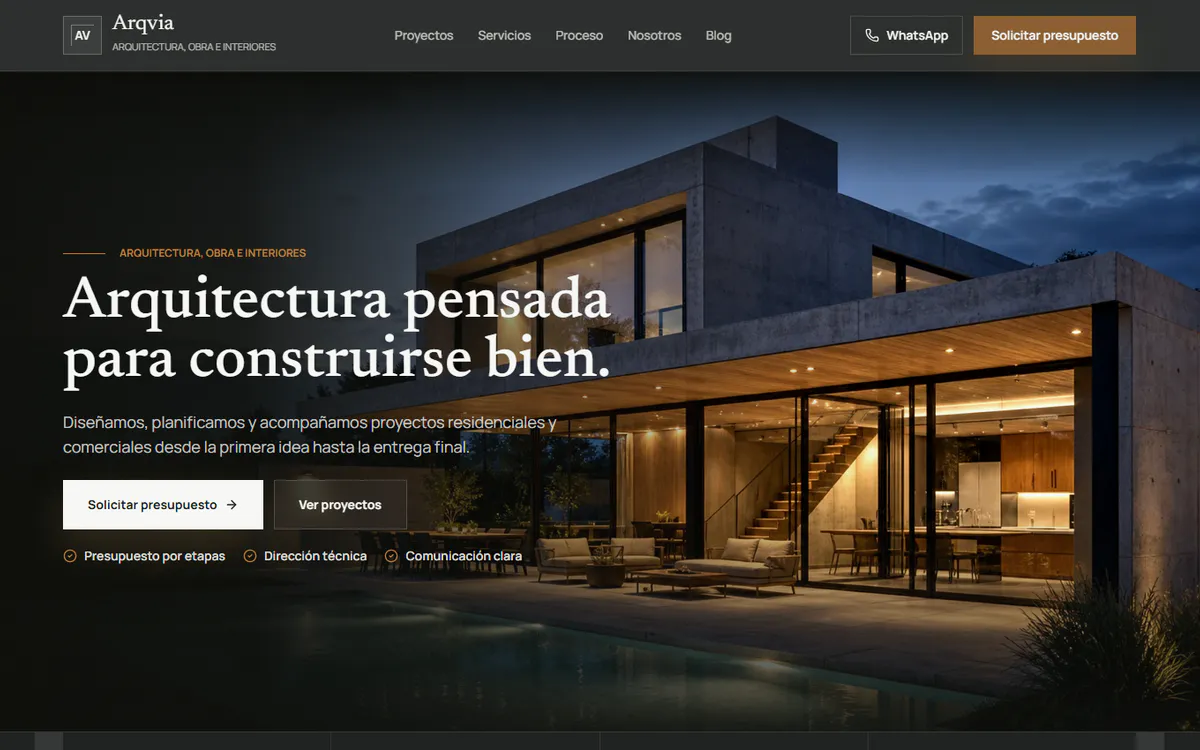
Arqvia was built to test whether treating those three as one system produces a materially different result — for the visitor deciding whether to make contact, and for the studio deciding what to do next.
Designing the inquiry as a conversation
The public site is organised around a single decision: is this studio right for my project. Services, process and case studies exist to answer that, and each one leads to the same next step.
The inquiry itself is progressive rather than a single wall of fields. Someone who is early can say so; someone with a defined project and a budget stage can say that instead. The form asks for what actually changes the response, and the studio receives a brief rather than a name and a sentence.
The portfolio is filterable by the dimensions a prospective client actually uses — sector and project type — instead of a reverse-chronological grid.
Roles, content and leads in one foundation
Behind the public site sits a role-based content and lead-management layer. Content is editable by the people responsible for it, and inquiries land somewhere with an owner and a state rather than in a shared inbox.
That boundary is the point of the exercise. A public site and an operations tool have opposite requirements — one is optimised for strangers and speed, the other for known users and completeness — and most projects fail at the seam between them.
What the build proves
Arqvia is bilingual on a progressive-web-app foundation, which is the same constraint most Argentine studios working internationally actually have: two languages, one codebase, no duplicated content.
It demonstrates the whole span this studio offers in a single artefact — commercial UX and content, a conversion-led public site, a designed inquiry flow, and the operational layer underneath it — rather than four separate examples that never have to work together.